Cinema as a Tool for Representing Western Sahara
Article by our Volunteer Research Assistant Silvia Mascheroni
Cinema forces us to look. It places us before the lived lives of other people. It allows us to experience, even if only for the duration of a film, the existence, daily life, values, and the identities of the subjects represented. It forces us to open our eyes.
For this reason, cinema plays a vital role in telling the story of, representing, and visualizing Sahrawi communities, as it serves as a powerful tool to share their hopes and the challenges they face.
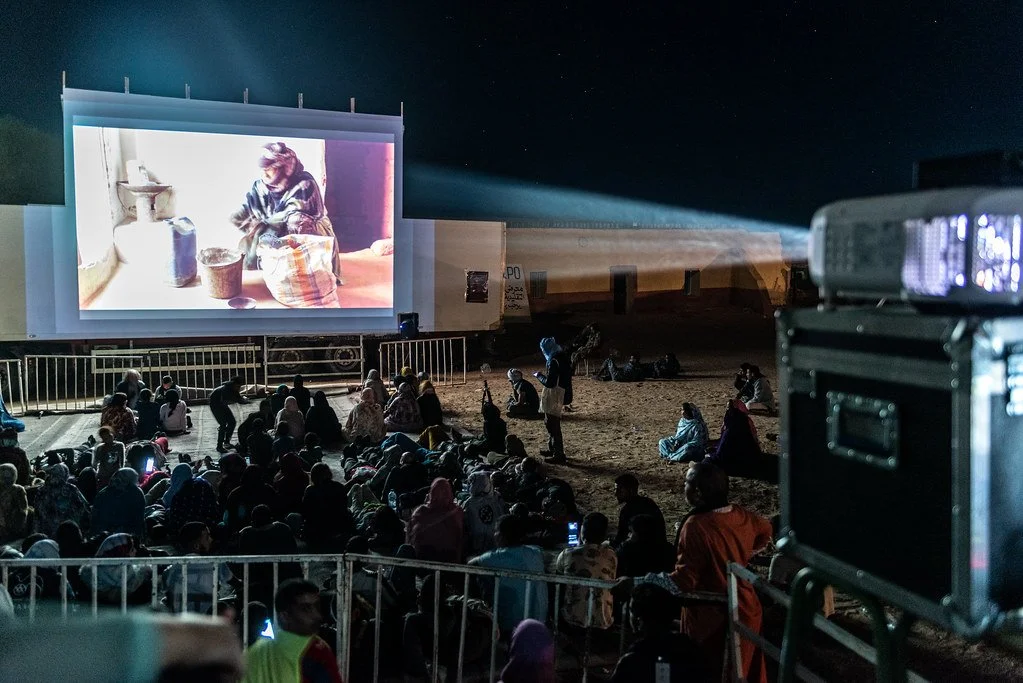
The FiSahara Film Festival taking place in the Sahrawi refugee camps in Algeria.
Sahrawis under Moroccan occupation, and in exile, struggle to preserve their cultural roots and pass down traditions across generations. Through films and documentaries, the Sahrawi community can safeguard and promote their culture, language, social and historical identity, since life in diaspora or under occupation poses a constant threat to the preservation of these vital values.
Movies are therefore not only a snapshot of the present, but they are also future-oriented. They look at the contemporary situation of values and culture to preserve it and reproduce it. This is vital in a context where the protection, preservation, and transmission of Sahrawi culture are essential for their very survival as a people.
International support is mobilized through cinema, by drawing global attention to the too-often-forgotten Sahrawi cause. It highlights human rights violations, injustices in the occupied territories, the serious humanitarian crisis faced by the Sahrawi people, and their ongoing demands for autonomy and independence. Through this, cinema can galvanize international backing.
“Acts of representation, and cinema among them, should always be considered as dynamics that hold power. ”
Culture is a powerful awareness-raising tool that can transcend political and diplomatic channels, connecting globally with civil society, media, and key decision-makers. Thanks to the progressive democratization of representation tools—whether they are devices for photos and videos, editing tools, or the increased accessibility of reproduction platforms—film productions have become more accessible today and serve as instruments of cultural and political resistance.
Cinema allows the Sahrawi to tell their own stories, overcoming barriers of external narration and providing an authentic, direct perspective on their culture, identity, and daily struggles. This is crucial to challenge practices, common especially in neocolonialist and neo-imperialist contexts, which represent oppressed peoples as victims, prevent marginalized communities from telling their own stories, and position subordinate groups solely as subjects of representation. Acts of representation, and cinema among them, should always be considered as dynamics that hold power. Those who speak their voice have strength and resonance.
Agents of Change
Efforts to Preserve and Encourage Self-Representation Through Film
Every narrative perspective adopted has an echo that influences and impacts what is represented. In this perspective, NOMAD is a great example of how to preserve and encourage the self-representation of the Sahrawi people, so that their agency, capacity, desire, and voice have representation and resonance. As an organization dedicated to human rights and media development in Western Sahara’s occupied territories and refugee camps, NOMAD implements projects such as film schools, workshops, and scholarships for film production. By doing so, they train a generation of Sahrawi filmmakers, while prioritizing work with women, youth, and children. They collaborate to organize the Western Sahara International Film Festival (FiSahara), along with initiatives to develop media and cinema.
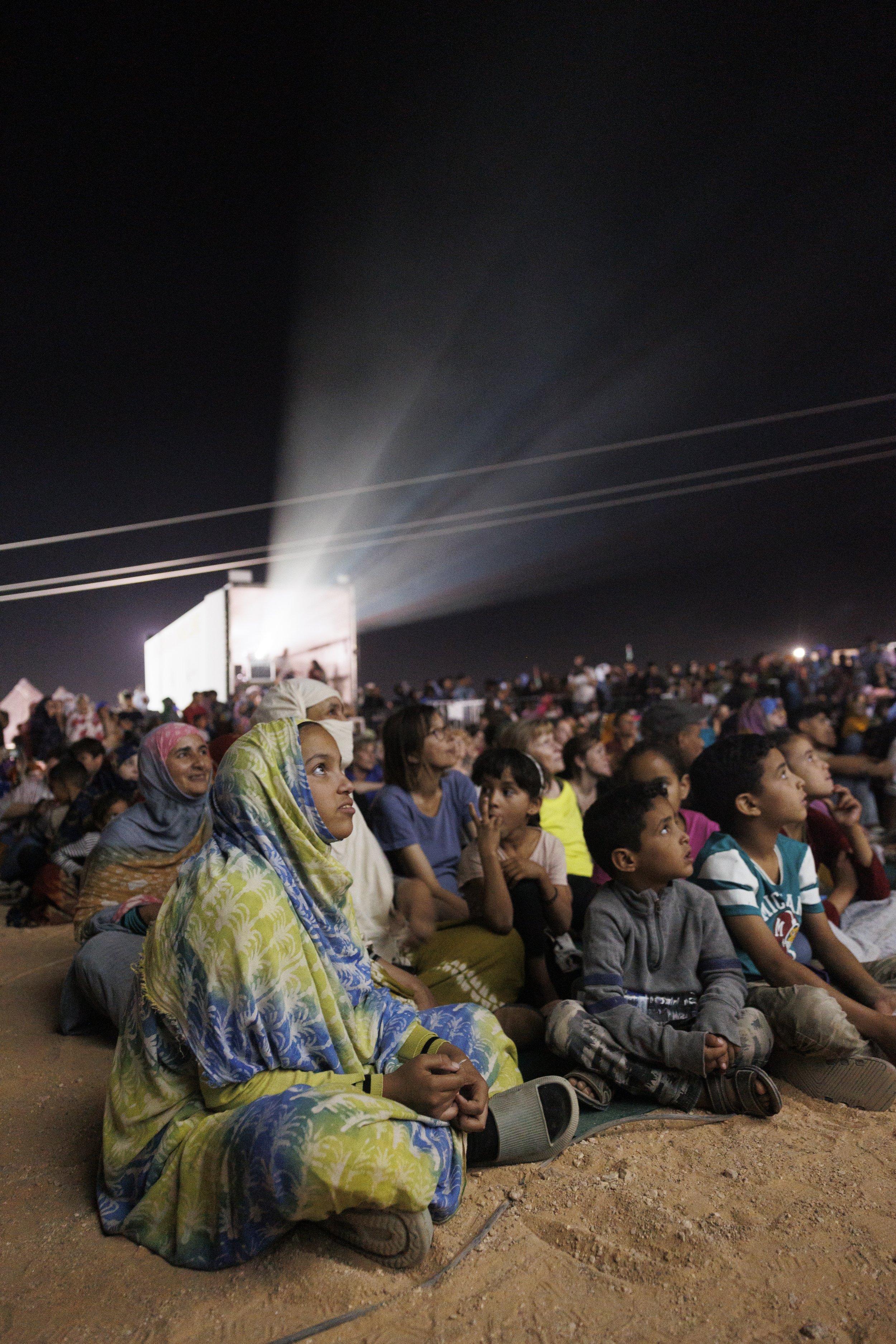
FiSahara’s objective is to build a path to liberation through cultural activism, with an eye on human rights and media advocacy. In their view, Sahrawi self-determination is not only a political goal but also a long-term national-building project, a present-day laboratory with a vision for the future. For this reason, they work on projects initiated and managed by the Sahrawi themselves, which require external support due to the difficult conditions in refugee camps and occupied Western Sahara.
Furthermore, NOMAD supports Sahrawi journalists, many of whom operate clandestinely and are among the few sources of information from the ground, due to Morocco’s near-total ban on international media. In parallel to media training for activists, they curate and disseminate videos filmed by citizen journalists and eyewitnesses, by making them accessible to international monitors and media through an online platform.
Alongside the support of the self-representation practices of the Sahrawi people, NOMAD offers a cinematographic archive created by international directors, spanning over fifty years of Sahrawi history and resistance. Film archives, including Nomad's archive and the new-born-and-expanding Sandblast archive, offer the opportunity to experience the Sahrawi struggle for independence from a diachronic perspective, observing its evolution over time and the changes in living conditions as the historical context changed.
Opportunities for Self-Representation
In addition to creating and overseeing opportunities for self-representation of the Saharawi people, it is essential to create spaces for the reproduction and enjoyment of cinematic content, both in Western Sahara and abroad.
Since its founding, Sandblast has hosted dozens of film screening events in the UK, and its film club has played a role in promoting film viewings. Concurrently, since 2003, FiSahara festival has brought film screenings, roundtables, workshops, concerts, parades, and children's entertainment to one of the world's most remote locations in the heart of the Sahara Desert. The aim of the festival, founded by Sahrawi cultural advocates in the refugee camps and Spanish civil society, is to promote cinema and draw international attention to the camps. It is now also a platform for cultural exchange, solidarity, and human rights advocacy, attracting journalists, filmmakers, and activists from abroad. FiSahara’s distinctive evening screenings are held outdoors and Sahrawi families and visitors from around the world watch movies, to explore human rights themes as well as for family-friendly entertainment. The festival is also the opportunity for screening FiSahara’s signature Western Sahara-inspired films, many of which were created by emerging Sahrawi filmmakers. These initiatives encourage and create space for diverse Sahrawi voices to produce and reproduce a plurality of complex stories that do not readily reinforce stereotypes and visions informed by the gaze of Western viewers.

Over the years, films that more or less directly address environmental issues in the Western Sahara region have increasingly appeared in the FiSahara festival's selection, as well as in the film archives of Nomad and Sandblast. Recurring themes include, among others: climate change in a context already marked by water scarcity; the presence of mines and dmining operations; and the phosphate mining industry and its impact on humans and non-humans.
In addition to cinema's already fairly obvious ability and scope to showcase the places, landscapes, and environments within which the Saharawi community lives and moves, this growing frequency in cinema's exploration of ecosystemic themes is significant not from a purely descriptive and documentary perspective, but because it highlights the complex and delicate relationship Sahrawis have forged with the surrounding landscape, despite Moroccan colonization's perpetration of violence against both the population and the natural landscape. While the focus on ecosystemic issues highlights the pervasiveness of colonial violence, it also highlights the set of practices that enable a new alliance between human and non-human beings, as a fundamental requirement for the continuation of life in all its forms.
Films set in Western Sahara have focused on the invisible social spaces and political landscapes where the Sahrawis create their daily lives of resistance to colonization.
They manage to portray the complex network of relationships that the Sahrawi community has been able to weave with the natural landscape, with its resources and its challenges. Films represent all this, not in a neutral descriptive key, but as a key to critically reading the present colonial relations of power, exploitation, and violation of human rights. In these representations, the Sahrawis are not passive objects of the representation, but manage to conquer their voice in the narrative, their agency in action, demonstrating awareness and memory of the past, the possibility and capacity to transform the present, and imaginative projection towards the future.
Cinema's ability to represent the world of the Sahrawi is particularly significant, not only as a means of testimony and documentation, but as a space for imagination and transformation. Films not only represent, but are themselves worlds with a collectively shared imaginative and symbolic capacity.
In the context of Western Sahara, cinema, once again, confirms its role as a tool for asserting identity, both political and social, as well as a collective laboratory for the future.